
TL;DR
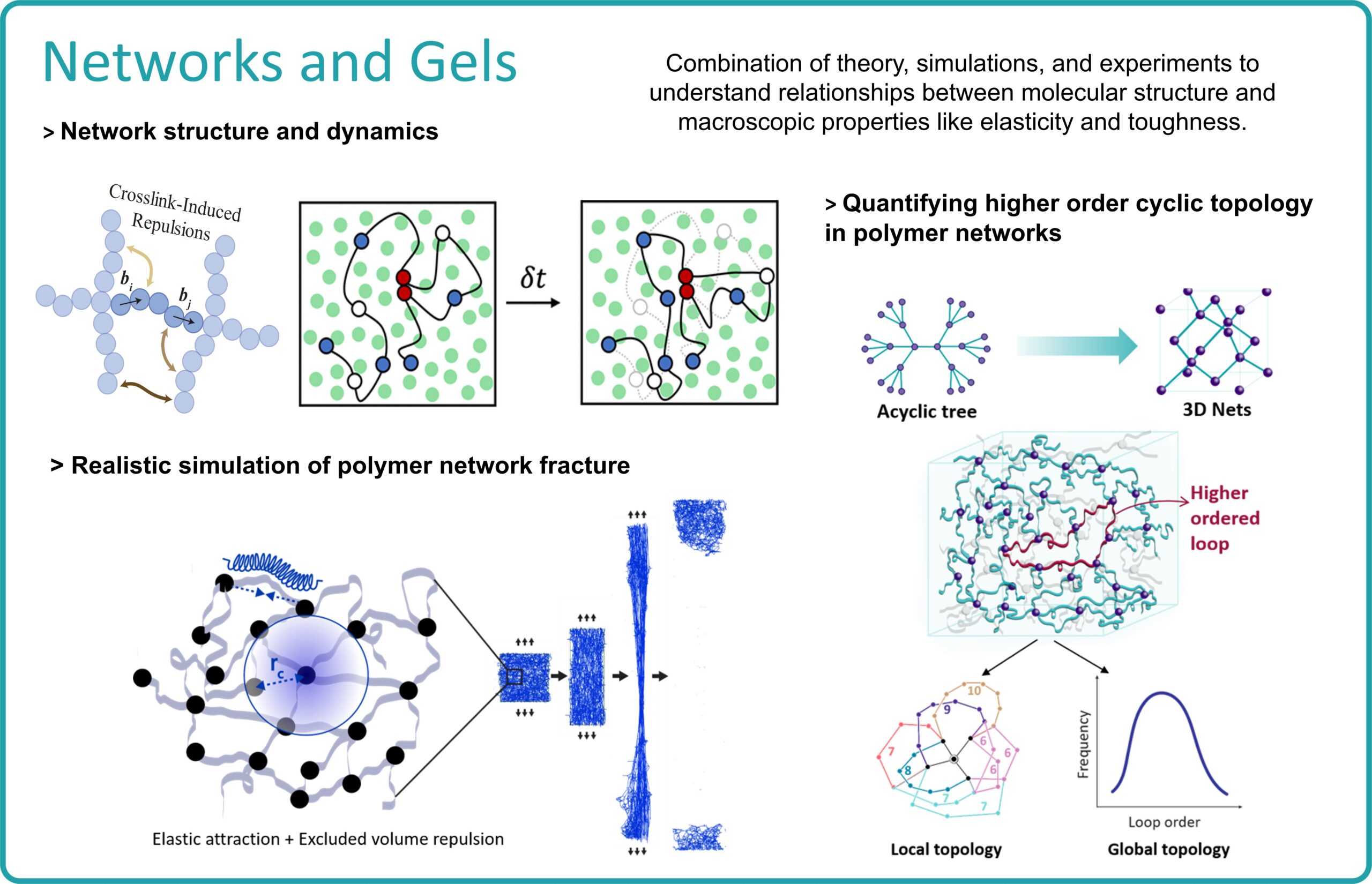
Polymer networks, Network topology, Networks
Selected Papers
Universal Cyclic Topology in Polymer Networks
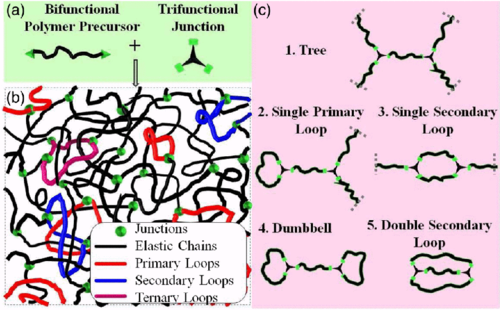
This work develops a unified theory for topological defects in polymer networks, particularly cyclic structures or loops that strongly influence network properties. Rather than treating different loop types as independently adjustable defects, the study shows that their populations are governed by a single dimensionless parameter describing network formation conditions. The theory quantitatively agrees with hydrogel experiments and Monte Carlo simulations without fitted parameters, while unifying the effects of polymer concentration and chain length on loop formation. Remarkably, measuring only the primary-loop fraction is sufficient to characterize the distribution of higher-order cyclic defects.
Fracture of Polymer Networks Containing Topological Defects
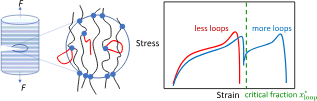
This work examines how topological defects in polymer networks influence fracture and failure behavior, extending the classical Lake–Thomas theory to explicitly account for primary loops and dangling ends. By combining this framework with the Flory–Stockmayer gelation criterion, the model predicts how defect populations affect tearing energy and ultimate strain. Although defects generally weaken networks by lowering fracture energy, increasing the primary-loop fraction can induce a transition from low to unusually high extensibility. Incorporating bond-scission kinetics further predicts that the sharpness of this transition depends strongly on strain rate. Experiments using PEG gels with known loop fractions closely match the theoretical tearing-energy predictions and provide evidence for the predicted extensibility transition.
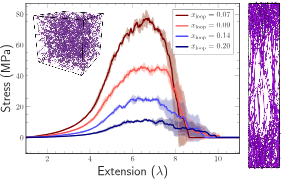
This study develops a coarse-grained simulation framework to predict elastomer fracture at experimentally relevant strain rates. The model incorporates nonlinear chain mechanics, mechanochemical bond breaking, and stochastic fracture. Simulations show that increasing primary-loop defects decreases network modulus while increasing ultimate extension, consistent with theory and experiments, though the extension increase is smaller than previously predicted. This discrepancy arises from stress redistribution between network defects as chains break, producing a more uniform stress distribution and synchronized failure. Overall, the work demonstrates how polymer-network topology governs fracture behavior and can be manipulated to design tougher, higher-performance elastomers.
Quantifying the impact of molecular defects on polymer network elasticity
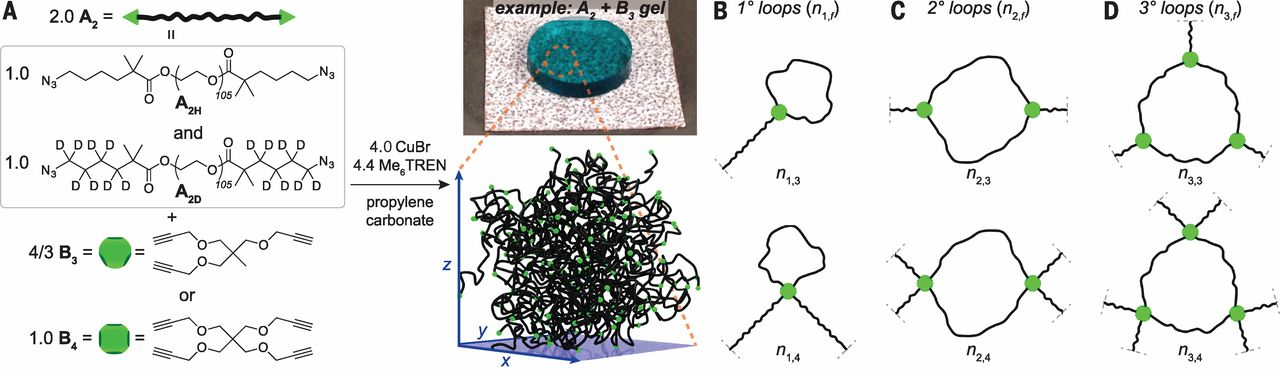 Elasticity, one of the most important properties of a soft material, is difficult to quantify in polymer networks because of the presence of topological molecular defects in these materials. Furthermore, the impact of these defects on bulk elasticity is unknown. We used rheology, disassembly spectrometry, and simulations to measure the shear elastic modulus and count the numbers of topological “loop” defects of various order in a series of polymer hydrogels, and then used these data to evaluate the classical phantom and affine network theories of elasticity. The results led to a real elastic network theory (RENT) that describes how loop defects affect bulk elasticity. Given knowledge of the loop fractions, RENT provides predictions of the shear elastic modulus that are consistent with experimental observations.
People
- Brian Carrick
- Masashi Ohira
- Raashiq Ishraaq